
Understand the current situation
Map what the team sees, what the customer experiences, what has already been tried, which tools are involved, and where the problem appears during real work.
The SocialCode method
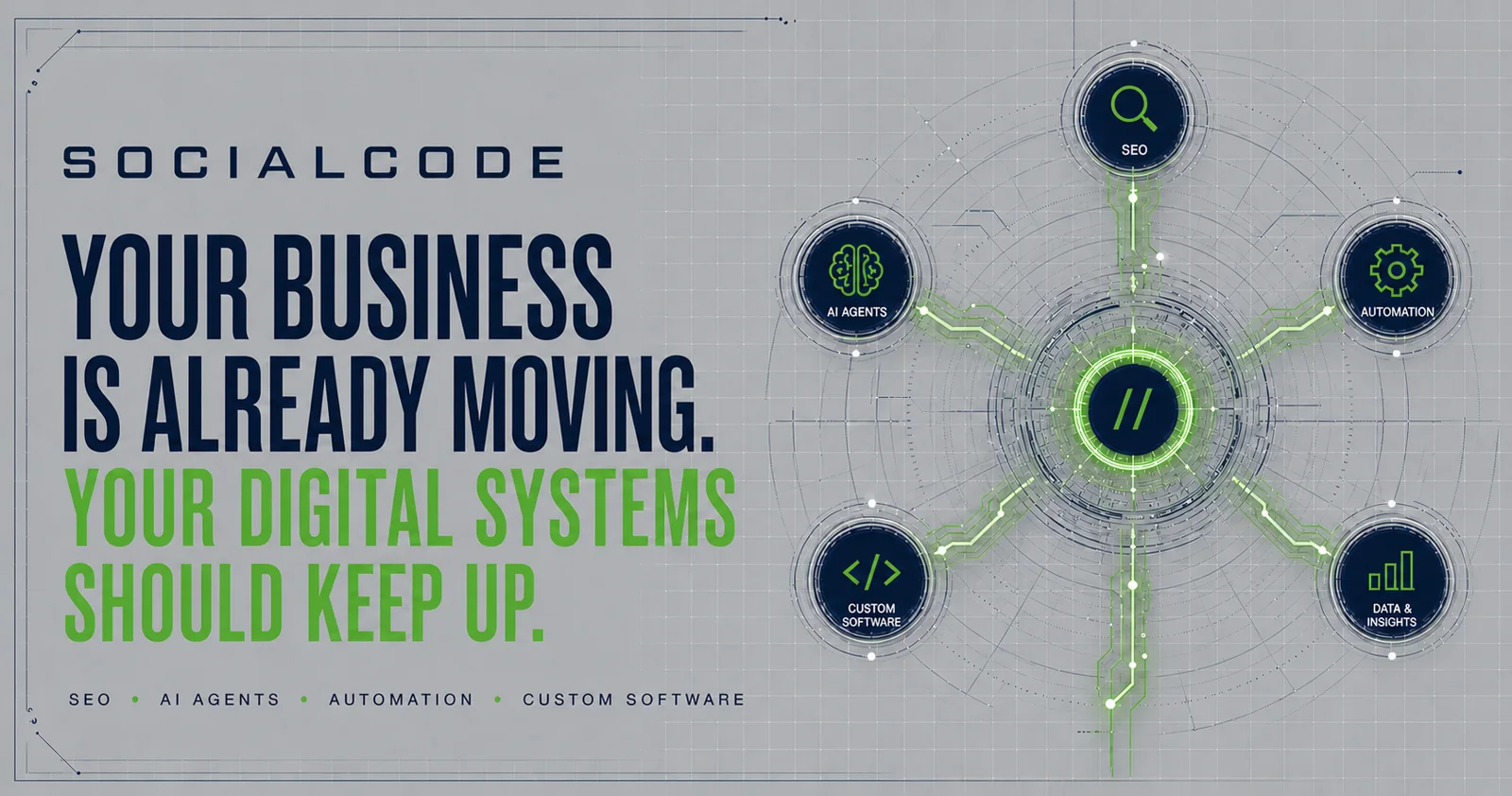
SocialCode starts with the business problem, not a predetermined service. We understand the current situation, diagnose what is causing the constraint, build the smallest useful system, connect it to the operation, and improve it against real customer, workflow, and revenue signals.
DIRECT ANSWER
New channels and software can create more complexity when the reason for the work is unclear. The SocialCode method keeps every decision connected to an observable problem, a responsible owner, a measurable change, and the operating conditions required for the system to keep working after launch.
Map what the team sees, what the customer experiences, what has already been tried, which tools are involved, and where the problem appears during real work.
Separate symptoms from causes and estimate what the constraint is costing in demand, response time, capacity, customer experience, information quality, or revenue.
Design the smallest useful solution, assign ownership and guardrails, connect the required tools and information, and test it against realistic operating scenarios.
Review customer behavior, conversations, workflow movement, adoption, quality, and revenue signals to improve the parts that create business value.
WHAT CHANGES
The company invests first in the constraint with the strongest business consequence instead of buying disconnected capabilities.
People know what the system does, where human judgment remains required, and who is responsible for exceptions or changes.
Success is defined by the movement the business needs, not by activity metrics that cannot be connected to an outcome.
QUESTIONS ANSWERED
Each answer is written to help you make the next decision without forcing a sales conversation.
We document the visible symptom, customer or employee impact, current workflow, systems involved, prior attempts, available evidence, and the consequence of the problem before recommending a solution.
No. The method is designed to find the smallest useful first move. That may be a focused page, integration, agent, workflow, measurement layer, or software release rather than a full transformation.
Measurement depends on the constraint. Useful signals can include qualified discovery, response time, booked work, process completion, exceptions, employee time recovered, adoption, customer movement, and revenue.
START WITH THE CONSTRAINT
Bring the visible symptoms, current tools, attempted fixes, and the consequence of leaving the problem in place. We will begin by making the decision clearer.
Start the diagnostic